


ABOUT PAINLESS LABOR

PAINLESS LABOR (LABOR ANALGESIA)
Introduction.
After fertilization, it will take it will take 280 days 40 weeks for the originary microscopic two cells, the sperm and ova to develop into a baby that has two be delivered by a vaginal birth or operative delivery at the end of the 280days. While everyone is joyfully waiting for the baby, often the mothers are worried about the pain, agony associated with child birth.
Child birth is the most painful event experienced in a mother’s life. It is compared to pain of digit amputation without anesthesia, or a second degree burn with cooking oil. While these happen for a few seconds, labor last about 12 to 16 hours of such pain. The pain of labor and delivery varies among women and each woman’s labor may be different for example abnormal presentation in one pregnancy but not in the next pregnancy
What causes pain during child birth.
Pain originates from different sites as the process of labor and delivery progresses. During the first stage of labor, pain originates from distension of uterine and cervical tissues. This spreads through nerves to the thighs, abdomen, buttocks and the back. Towards delivery the labor becomes more severe. It includes a combination of uterine contractions, cervical stretching, distension and tearing of structures in the birth canal.
Does God approve painless labor.
Labor pain has prevailed as long as mankind has existed. The old testament contains numerous references to pain as being synonymous with sin as a punishment for humanity. It was the price that women had to pay for being the cause of man’s exile from paradise Genesis 3:16. “and the Lord God caused deep sleep to fall upon Adam and he sleep and he took one of his ribs, and closed up the flesh” Genesis 2:21. God administered anesthesia, (pain control) to the man for him NOT to go through the agony of pain while man accepted the Lord God to use him to make the woman, thus anesthesia, (pain control) while bring to life other human beings (child birth) is divinely accepted.
Is painless labor a new thing.
In 1847, Simpson carried out the first labor analgesia and was Knighted by her megacity Queen Victoria for his contribution to Obstetric analgesia. Queen Victoria endorsed the new discovery that she accepted Dr. John Snow to administer labor analgesia for her while giving birth to her Eight born, Prince Leopold in 1853. She expressed great relief from the application of labor analgesia, * the pains being trifling during the uterine contractions, the queen said* This made Queen Victoria the first monarchy to give birth to a child under anesthesia.
I painless labor popular.
The use of labor analgesia is common in high income countries but very low in Africa. A survey conducted in 13 high income countries in 2020 found its use varying between 10% to 83% varying with geography. In the USA 4 out of 5 first time mothers receive labor analgesia. A study of 1293 laboring mothers by Dr. Mary Nabukenya in 2015 in Mulago National referral hospital revealed that only 7% of these participants had knowledge of labor analgesia. 88.7% of these mothers wanted labor analgesia for the next delivery.
How can one reduce pain during child birth?
Breathing techniques: Increasing intake of air during labor has been shown to reduce labor pains.
Warm water births: Being in warm water has been found effective in the first stage of labor. Aiming warm water directly onto the lower back may feel pleasant and reduce pain significantly
Massage and counter pressure: Foot, hand, back shoulder may be beneficial. 15 minutes of massage each hour has been shown to alleviate pain
Movements: Walking, rocking on a birthing ball or even slow dancing with a partner can help labor progress and relieve pan
A TENS unit: Many people have found some pain relief during labor by stimulating their lower back with a Transcutaneous Electrical Nerve Stimulation (TENS)
IV Opioids: These are strong painkillers that are administered through injecting the muscle or intravenous route. Pain relief is limited. Will make the mother drowsy, slow the breathing and may make the baby drowsy after delivery especially if give within an hour from the time of delivery.
Entonox: This is a mixture of oxygen and nitrous oxide that the mother breathes through the mask. Mother is asked to start breathing as soon as she feels the contraction coming.
Epidural/Spinal birth analgesia
This is the most effective method of labor analgesia. This method relieves pain by admission and pain relieving medicines near the spinal cord to the epidural. It is safe, effective and very popular. It is similar to what you get at the dentist but in very low dosage. It is introduced into that space through a catheter. It can be a continuous infusion with a machine or a mother can ask for top ups. Since it is continuous, it never runs out.
When does a mother get the labor analgesia.
Maternal request alone is a sufficient medical indication for labor analgesia. Some women want until labor pains are intense while others want labor analgesia as soon as labor begins
Complications of epidural anesthesia.
Maternal/fetal health risk are extremely low. The risk of hematoma is less than 0.001%, the risk of nerve damage is 0.0003%. 0.7% of mother’s experience puncture headache which is position related, worse while standing, better while lying down. Some mothers will experience itching at the incision site, low blood pressure and some numbness which may affect movement. All these complications are manageable.
Which mothers are not fit for painless labor
Mothers with bleeding disorders: Mothers with bleeding disorders, those receiving blood thinning drugs for clots in the limbs are at an increased risk for spinal bleeding during or after epidural anaethesia
Systemic or local skin infection: Mothers with systemic infections and with skin infections at the site of spinal or epidural needle puncture may be at increased risk for the brain. Chronic infection with HIV diabetes is NOT considered a contra indication to epidural anaethesia
Spine abnormalities: Mothers with abnormal spines may be technically challenging or impossible or associated with increased risk of neurologic complications
Commonly asked questions
Does epidural anaethesia increase the risk of delivery by caesarean section?
No, epidural anaethesia does NOT increase the risk of delivery by caesarean section. Several Cochrane reviews have undermined the hypothesis that labor analgesia causes an increase in caesarean sections.
Does labor analgesia slow the progress of labor?
Labor analgesia may slow the progress of first stage of labor by about 30 minutes and the second stage of labor by 7.6 minutes. However, this delay is insignificant compared to the usual about 12 to 16hours of normal labor.
Does labor analgesia increase the risk of backache?
No, it does NOT. About 20 to 70% of women that give birth whether by operative delivery, vaginal delivery or epidural analgesia will experience back aches. The back pain starts during pregnancy due to stretching of the uterus and abdominal muscles that strain the back, extra weight gain, stretching of the ligaments and joints that attach the pelvis to the spine, bad posture during breast feeding, over exhaustion due to sleepless night and days while taking care of the baby. This can be managed by gentle exercises, standing and sitting upright, proper positioning while breast feeding, finding time for self-care.
Does labor analgesia affect fetal outcomes and increase rate of admission to SCU?
No, there is no difference in fetal outcomes, APGAR score and admission to nursery after for babies delivered under labor analgesia.
In summary
When choosing a labor analgesia, please note that this is your experience. There is no acceptable reason for a person to experience untreated severe pain under the physician’s care. I wish every mother to have the very best experience during child birth. If NOT ready for medicines, pick another method of pain control to help you cope with the pain. Any choice you make is great for you and be flexible about your choices.
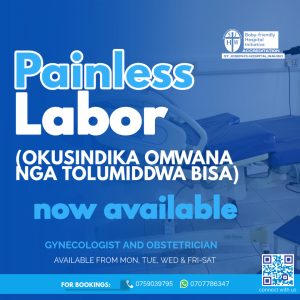
This moderlity of child birth is now available at St. Joseph’s Hospital Wakiso
Written by Dr. Nicholas Mugagga (Obstetrician and Gynaecologist @ St. Josephs Hospital Wakiso)
tap link below to watch an interview of our Gynecologist and Obstetrician , Dr. Nicholas Mugagga.


